
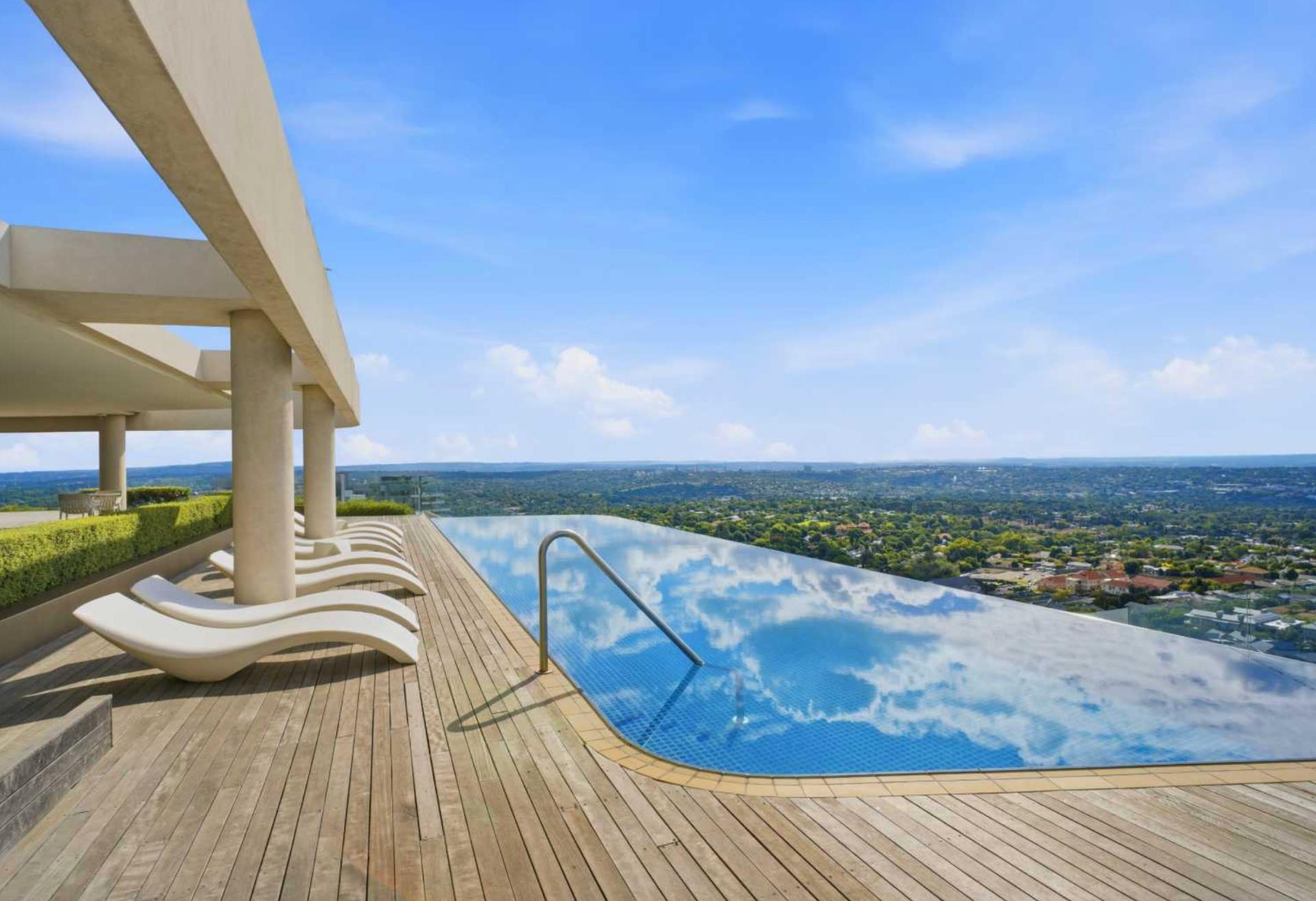
The Vertical Address
There's a quiet shift happening in Sandton's upper market, and most buyers haven't caught it yet.
Twenty years ago, the question every successful Johannesburg buyer asked was the same: which suburb, which stand, which house? The answer always pointed horizontal. Bigger plot, bigger garden, bigger wall, bigger security cost. The house was the prize. Everything else organised itself around it.
Today, a growing portion of those same buyers are asking a different question. Where do I actually live well — with the least friction and the most life? And increasingly, the answer is pointing up rather than out.
What the market is showing
Industry analysis from sources including Lightstone and FNB Property Insights has tracked the same trend across several years: the high-end sectional title market in Sandton, Morningside, Atholl, and surrounding upper nodes has been resilient, often outpacing comparable freehold stock through cycles where stand-alone luxury has softened. Sectional title dominates the Sandton market — accounting for 57,5% of all residential sales.
The demographic drivers are remarkably consistent. South African empty nesters trading down from family homes. Professional couples without children. Frequent business travellers. Returning expats. The new generation of high-income earners under forty who want a Sandton address without the Sandton house. The motivations differ across these segments. The conclusion is the same.
Security at the building level
Security in a freestanding Sandton home is the homeowner's job to design and the homeowner's responsibility to maintain. Perimeter walls, electric fencing, beam alarms, armed response contracts, dogs, internal cameras, panic buttons, security gates at multiple points. The peace of mind is real but it is purchased one component at a time and renewed annually.
Security in a well-run high-end apartment building is built into the architecture. Controlled access, twenty-four-hour security staff, biometric or coded entry, visitor protocols, CCTV coverage of every common area, secure parking with controlled access. The cost is shared across every owner. The system is operated by professionals. The owner's role reduces from operator to occupant.
For families, that is convenience. For owners who travel regularly, it is the difference between leaving home and closing a door.
Location as the silent advantage
A house in even the best Sandton suburb sits in a postcode. An apartment in Sandton CBD or Morningside sits inside a neighbourhood. The difference matters.
From a Morningside tower, the geography compresses. Sandton City, Nelson Mandela Square, the Gautrain station, the restaurant strip along Rivonia Road, fitness studios, medical specialists, schools, the M1 north and south on-ramps — all of it sits within a five-to-seven-minute drive. In a city like Johannesburg, where commute time is consistently the most underestimated daily cost of property choice, that geographic compression compounds across every week of every year you live there.
The Gautrain has quietly reshaped the calculation further. A Sandton apartment puts the owner roughly fifteen minutes from OR Tambo by rail, transfer at Marlboro included. For business travellers and international flyers, that single fact has become a material part of the address.
The lock-up-and-go advantage
A freestanding house demands attention even when the owner is not there. The garden doesn't pause. The pool needs maintenance. The security system needs monitoring. A neighbour, housekeeper, or staff member has to be coordinated for any extended absence. Insurance policies account for this — long absences from a standalone home often trigger reduced cover or higher premiums.
A serviced high-end apartment removes all of it. Lock the door, board the flight, return three weeks later to a home that operated itself. The garden was maintained, security operated, the pool managed, the lobby cleaned, parcels received at the desk. The owner is back from a trip without first having to come home from one.
For owners with second homes, international business interests, or any pattern of regular travel, this is not a small thing. It is the structural argument for the apartment over the house.
The investment angle most buyers still underestimate
A persistent assumption in the South African market is that freehold homes outperform sectional title over time. In Sandton specifically, that assumption is increasingly out of date.
The reasons are structural. The supply of premium-grade Sandton apartments is constrained — buildable land in the core walking-distance neighbourhoods is limited. Demand from professionals, downsizers, returning South Africans, and foreign buyers is sustained. The buildings that are well-constructed, well-managed by competent body corporates with strong reserve funds, and located in genuinely walkable nodes are simply not being added to the market in unlimited quantity.
Scarcity, in property as anywhere, compounds.
The new luxury, properly defined
The luxury of a Sandton apartment isn't the absence of space. It's the presence of choice — about how you spend your weekend, about how often you travel, about how much of your week you give to running a property versus living in one.
The buyers making this move aren't retreating from the family home. They're graduating from it. The next decade of their life looks different from the last, and the home they choose says so.
Two Morningside towers worth knowing about
Both of the highest-end developments currently positioning themselves in Sandton Morningside demonstrate exactly the principles above — secure, convenient, restaurants at your doorstep, designed-for-purpose vertical living for the kind of buyer this piece describes.
Masangita Towers and Central Square are both in Morningside, both reflect the new generation of high-end Sandton apartment design, and both are worth viewing if any of the above lands with you.